
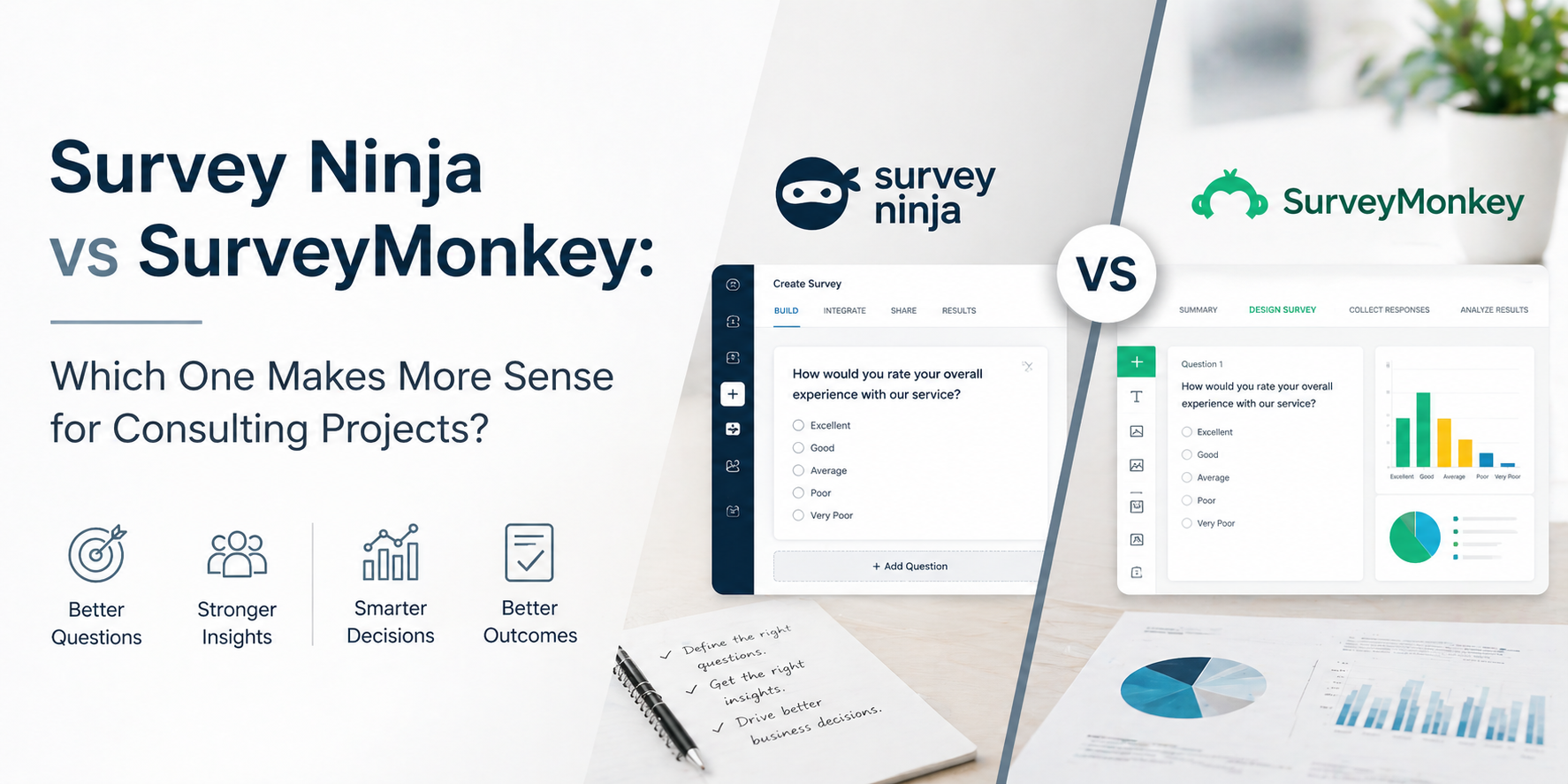
Survey Ninja vs SurveyMonkey: Which One Makes More Sense for Consulting Projects?
When a consulting project includes surveys, the real question is usually not which platform is “better” in general. The more useful question is which one fits the consulting task more naturally. Some projects need speed, simplicity, and a low-friction respondent experience. Others need more structure, more method support, and a more layered survey design. That is why the choice between Survey Ninja and SurveyMonkey should be made in context, not by reputation alone. Survey Ninja presents itself as a survey builder for feedback, market research, and segmentation with logic jumps, built-in analysis, templates, exports, and integrations. SurveyMonkey positions itself around advanced survey creation, expert-written questions and templates, logic, reporting, and broader business integrations.
Consulting projects do not all need the same kind of survey tool
In consulting work, surveys are not always used for the same purpose. One project may need quick customer feedback on a service issue. Another may involve offer evaluation, segmentation, or a more formal client study with multiple respondent paths. In some cases, the consultant mainly needs a clean and fast way to gather structured input. In others, the survey itself becomes a more central part of the consulting method. That is why platform fit matters so much. Survey Ninja explicitly highlights customer feedback, market research, quality assessment, segmentation, and sociological-style questionnaires, while SurveyMonkey emphasizes templates, expert question banks, logic, reporting, and integrations across business workflows.
When Survey Ninja makes more sense
Survey Ninja is often the better fit when a consulting project needs to move quickly and keep the respondent experience simple. It has an intuitive builder, logic jumps, built-in analytics, templates, integrations, adaptive design, and support for feedback forms, customer surveys, market research, and segmentation. As also mentioned in Survey Ninja review, that makes it especially practical for short consulting studies, service feedback checks, demand validation, quick stakeholder input, or projects where completion rate and ease of use matter more than building a highly layered survey architecture.
For small business consulting in particular, that lighter setup can be a real advantage. Many consulting clients do not need a complicated research environment. They need a straightforward way to gather opinion, test an assumption, or collect customer input before making a decision. Survey Ninja’s focus on ready-made templates, practical feedback flows, dashboards, exports, and low-friction use cases makes it well suited to those consulting situations. Its customer-feedback use case pages also highlight NPS, CSAT, branching, alerts, templates, and trend dashboards, which are useful when consultants want fast signals rather than a heavier research program.
When SurveyMonkey is the better fit
SurveyMonkey becomes the stronger option when the consulting project needs more formal structure or when the survey design itself requires more control. It offers advanced logic, expert-built templates, question banks, privacy and compliance features, integrations, automated workflows, reporting, and professional services for survey programming, customer journey mapping, reporting, and distribution. That combination makes it a stronger fit for consulting projects that involve more deliberate methodology, more segmented respondent paths, recurring programs, or stakeholder groups that require a more structured survey environment.
This matters especially when the consultant is working on a broader engagement rather than a one-off feedback task. If the project includes multiple audiences, more detailed comparison, or a more formal decision process, SurveyMonkey’s structure can be helpful. Its template library, certified questions, logic options, and wider integration ecosystem also make it easier to embed surveys into a larger consulting workflow where the results need to feed into reporting, CRM tools, or cross-functional collaboration.
The best choice depends on the consulting objective
The simplest way to compare the two is this: Survey Ninja often makes more sense when the consulting need is fast, focused, and practical, while SurveyMonkey often makes more sense when the project is more structured, more layered, or more enterprise-like in how it needs to run. Survey Ninja’s positioning around quick customer surveys, feedback forms, segmentation, web embeds, and built-in analysis supports that lighter consulting use case. SurveyMonkey’s positioning around advanced logic, certified templates, integrations, reporting, and professional services supports the more formal side of consulting research.
That also means the right answer may change from one client to another. A small local business trying to understand why customers hesitate may benefit more from a simple, accessible survey flow. A more complex consulting assignment involving multiple groups, more deliberate survey design, or recurring reporting may benefit more from SurveyMonkey’s stronger framework. The platform should support the consulting question, not dictate it. SurveyMonkey’s own customer journey mapping and reporting services make that especially clear for larger projects, while Survey Ninja’s feedback and research pages show how well it fits practical, fast-moving use cases.
Final thoughts
For consulting purposes, Survey Ninja and SurveyMonkey are both useful, but they solve slightly different problems. Survey Ninja is often the better fit when the project needs speed, clarity, and a lighter respondent experience. SurveyMonkey is often the stronger fit when the consulting task requires more formal design, more logic, more workflow integration, or more method support. The smartest choice is not the most famous tool or the one with the longest feature list. It is the one that best supports the kind of decision the consulting project is meant to improve.